
Is That Normal?
We use the word two different ways. Only one of them opens a door.

Parents ask me this more than anything else.
He still isn’t reading and he’s six. Is that normal?
She melts down every afternoon at four o’clock. Is that normal?
He’d rather be alone than with the other kids. Is that normal?
For a long time I answered it the way anybody would. I’d run through the children I’ve taught, find one who did roughly the same thing, and say: yes, that’s normal, plenty of kids do that.
Honest answer. Wrong question.
Because two questions are hiding inside that word, and the parent in front of me is usually asking the second one while I answer the first.
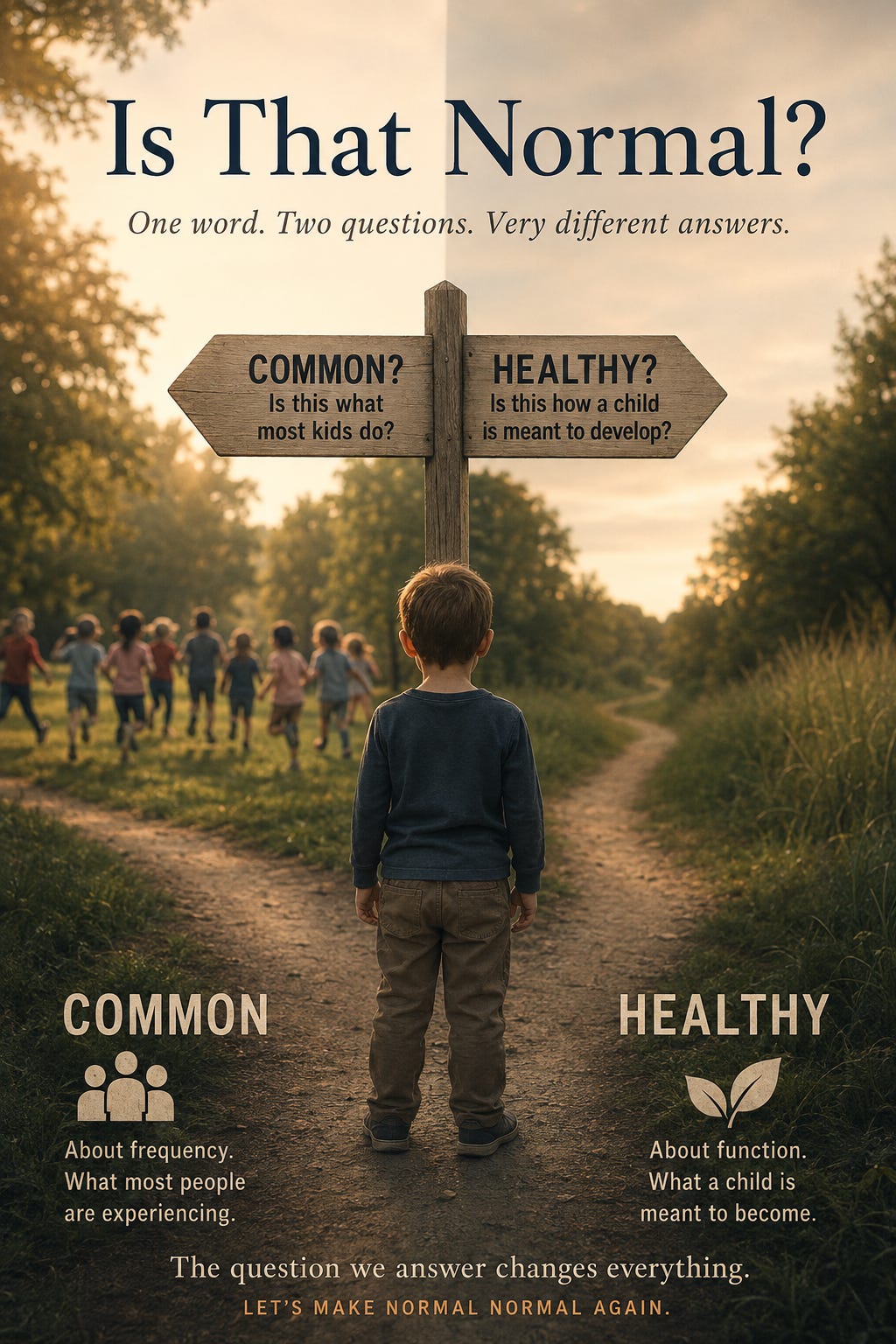
Question one: is this common? Do other children do this? Am I the only one?
Question two: is this healthy? Is my child developing the way a child is supposed to develop?
We have gotten remarkably bad at telling those apart.
There’s one corner of life where we never mix them up.
When your doctor says the bloodwork came back normal, you do not hear your numbers look like everybody else’s. You hear your body is working.
A normal heart isn’t an average heart. It’s a heart that does what a heart is for.
A normal immune system isn’t the one most people happen to have. It’s one that functions.
Doctors use normal as a word about function, not frequency. And tucked inside that usage is a claim that turns out to be enormous: that a body is a definite kind of thing, with requirements you can find out. Not preferences. Not fashions. Requirements.
Medicine bet everything on that claim. You are reading this because the bet paid.
Now watch the word cross over into the mind.
Anxiety is common — so we name the era after it.
Attention comes apart — so we call that the way we live now.
Loneliness spreads — so we call it modern life.
Every time the number climbs, the definition quietly widens to accommodate it. Eventually normal means nothing more ambitious than what a lot of people are currently going through.
I’ve come to think this is not a semantic quibble. It’s a fork in the road, and the two branches don’t reconverge.
Take normal to mean average. Then whatever most children are — jumpy, anxious, unable to stay with anything for long — is simply what a child is. There is nothing under it. Nothing to look for. The question shuts before anyone opens it.
Take normal to mean healthy. Now the same behavior is a departure from something. Departures have causes. Causes can be found.
One meaning ends an inquiry.
The other starts one.
So I try to answer both questions now, in that order.
Yes — it’s common. Other children do this. You are not the only one, and you have not failed him.
And then the harder one, which I’ve stopped skipping: I don’t think it’s how a child is meant to develop.
I want to be careful here, because there’s a version of this that sounds like consolation and isn’t. When a cardiologist tells a man his arteries are abnormal, nobody in that room feels relief. It’s a frightening sentence. What it is not is an accusation — and what it comes with is a search: a cause, a protocol, a thing to do on Monday. The word doesn’t comfort him. It puts him inside a system that has been looking for two generations and has answers.
Here is the honest part.
For the developing mind, we do not have that system yet. I can tell a parent this isn’t how a child is meant to develop and I cannot follow it with the protocol. There isn’t one. Not in the way there is for arteries.
So the second answer buys you no comfort at all in the short run. What it buys is a question that stays open — and an open question is the precondition for every answer we eventually got about the body.
That’s the whole trade, and I’d rather be straight about it than dress it up.
Which leaves something small that costs nothing and is available today.
Hold the two meanings apart. When someone tells you a thing is normal, notice which one they mean. Notice how often we let lots of people are like this stand in for this is how a person is meant to be — and how much stops getting looked into the moment we do.
That’s not a solution. It’s the move that has to come first.
This is one of the ideas at the center of my book in progress, The Achievement of Normal.
If you’ve ever asked a teacher, a pediatrician, or a search engine “is that normal?” — what were you actually asking? Hit reply and tell me.
I’m writing a book called The Achievement of Normal. Subscribing is how you’ll hear when it’s out.