
The Upper Elementary Mind

One of the most defining qualities of the child between 9 and 12 is their deep attraction to patterns. At this stage, the mind is not content with isolated facts. It seeks relationship, structure, and law. This is the birth of true intellectual thinking.
In Upper Elementary, this unfolds as a natural three-stage cycle of development:
Patterns → Precision → Principles
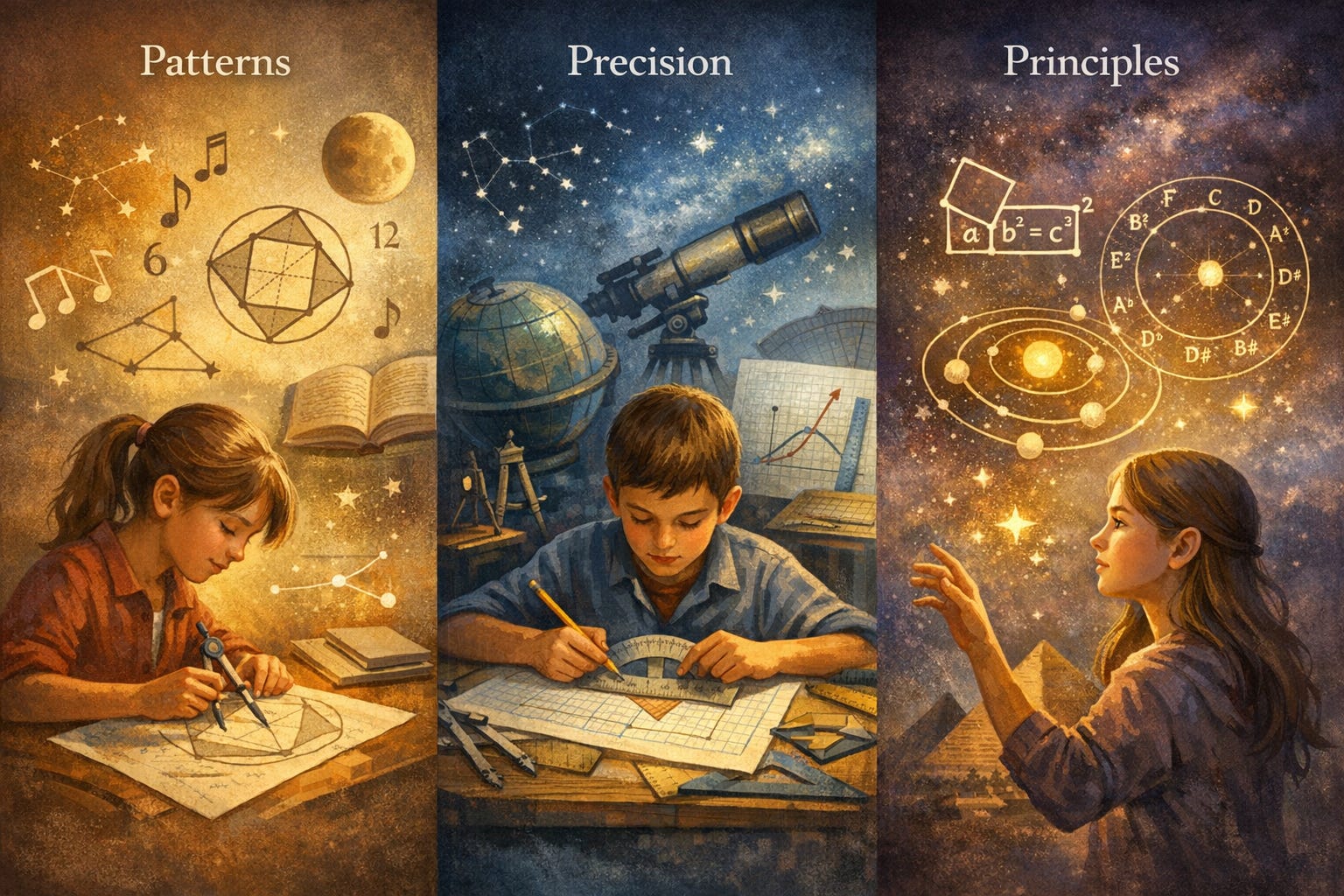
This cycle does not repeat endlessly. It is a developmental window — and if it is not fully completed, something profoundly important is lost.
1. Patterns: The Child Discovers Order
In the first pass through the Upper Elementary curriculum (typically the fourth year), the child becomes a pattern-finder. They begin to see that the world is not random — it is governed by repeating structures and relationships.
We see this everywhere:
Music: Patterns in scales, intervals, and transposition — how sequences of tones repeat and shift while preserving internal logic.
Mathematics (Arithmetic): The discovery of numerical patterns through concrete arithmetic — operations, multiples, factors, divisibility, powers, and roots. Number behaves in recognizable and predictable ways.
Geometry (Blank Paper): Patterns are discovered by constructing and analyzing shapes with a compass and ruler. Relationships are discovered, such as:
An inscribed square always having half the area of its circumscribed square
The squares of the legs of a right triangle equaling the square of the hypotenuse
Astronomy: The recognition that the Sun, Moon, and planets all move through the zodiac constellations, each with its own rhythm and speed.
Language: Through sentence diagramming, children recognize recurring structures in how words function to create meaning — predictable architectures of thought.
This stage is qualitative. It is wonder-filled. The child is saying: There is order here.
2. Precision: The Child Measures What They See
In the second pass (typically the fifth year), the child moves from noticing patterns to measuring them. What was once intuitive becomes exact. Numbers begin to confirm what the eye and hand already suspected.
Within this stage, the shift into precision becomes visible, with a particular emphasis on measuring in music, geometry, and algebra:
Astronomy: Students learn to measure altitude and azimuth of celestial bodies and track their motion on an azimuthal grid.
Geometry (Graph Paper): Working on graph paper allows students to numerically verify relationships they first discovered on blank paper:
That the squares of the legs equal the square of the hypotenuse
That each inscribed square is exactly half the area of the larger one
Music: Students are measuring frequency and discovering that:
An octave is double the frequency of its tonic
A perfect fifth is 1.5 times the tonic
Mathematics (Algebra): Students begin using numbers and symbols to describe and measure patterns rather than merely observe them. This includes:
Measuring the sum of a series of numbers
Measuring the sum of a series of cubes
Measuring the sum of a series of odd numbers
The child now says: The pattern is real — and I can prove it.
3. Principles: The Child Abstracts Universal Law
This is the culmination — and the most fragile stage. After discovering patterns and confirming them through precision, the child is meant to rise into principles: abstract truths that exist beyond any single example.
This is where thinking becomes truly abstract and conceptual.
Examples of this stage include:
Geometry:
The Pythagorean Theorem
The principle that a triangle formed from the altitude of another equilateral triangle is three-quarters the area of the original
Astronomy:
The understanding of the ecliptic — the governing plane and law of planetary motion
Music:
The Circle of Fifths, revealing the deep architecture behind harmony and tonal movement
Mathematics (Calculus):
The study of infinite series whose sums cannot be precisely measured, but must be imagined and abstracted
Eg. The infinite sum of repeated halves approaches one.
Eg. The infinite sum of repeated thirds approaches one half.
Patterns extended beyond concrete quantity toward infinity
Here, the child is able to express principles–already discovered and measured–in abstract terms.
Why This Sequence Matters
If a child sees patterns but never measures them, understanding remains vague. If they measure but never abstract principles, knowledge remains trapped in the concrete. But when all three stages are completed, the child crosses a threshold into true intellectual independence.
This three-stage cycle is rarely recognized or supported in conventional public education. Most children are asked to move quickly through content, memorize procedures, and accept finished formulas without ever experiencing the full developmental arc that leads to genuine understanding. Principles are often given, not discovered.
What we are honoring here is fundamentally different. It recognizes that the ages of 9–12 represent a unique window in which the child is meant to move from noticing, to measuring, to abstracting law. When this cycle is interrupted, the child misses the chance to fully develop the kind of mind that can reason, generalize, and discover.
Completing the arc — Patterns → Precision → Principles — is not an academic preference. It is a developmental necessity. When it is fulfilled, the child gains more than knowledge. They gain clarity, coherence, and the experience of truth emerging from their own thinking.
This is the quiet revolution happening in Upper Elementary: a profound respect for the way the child's mind is meant to grow — and the protection of the path that allows it to do so.