

In 1907 a physician walked into one of the poorest neighborhoods in Rome to keep some children occupied while their parents worked.
The children of San Lorenzo were regarded, by nearly every adult around them, as noisy, destructive, and undisciplined. That was simply what everyone knew children of that district were like.
Maria Montessori did not walk in with a philosophy of education. She walked in as a scientist — and it’s worth noticing what kind. Medicine was the one discipline that had already learned to treat an organism as something with a definite nature, whose health is objective, whose disorders have causes, whose requirements can be discovered. Of course it was a physician who first looked at a child’s mind that way.
She brought in the one assumption education had never made: that she was observing a natural organism, governed by laws.
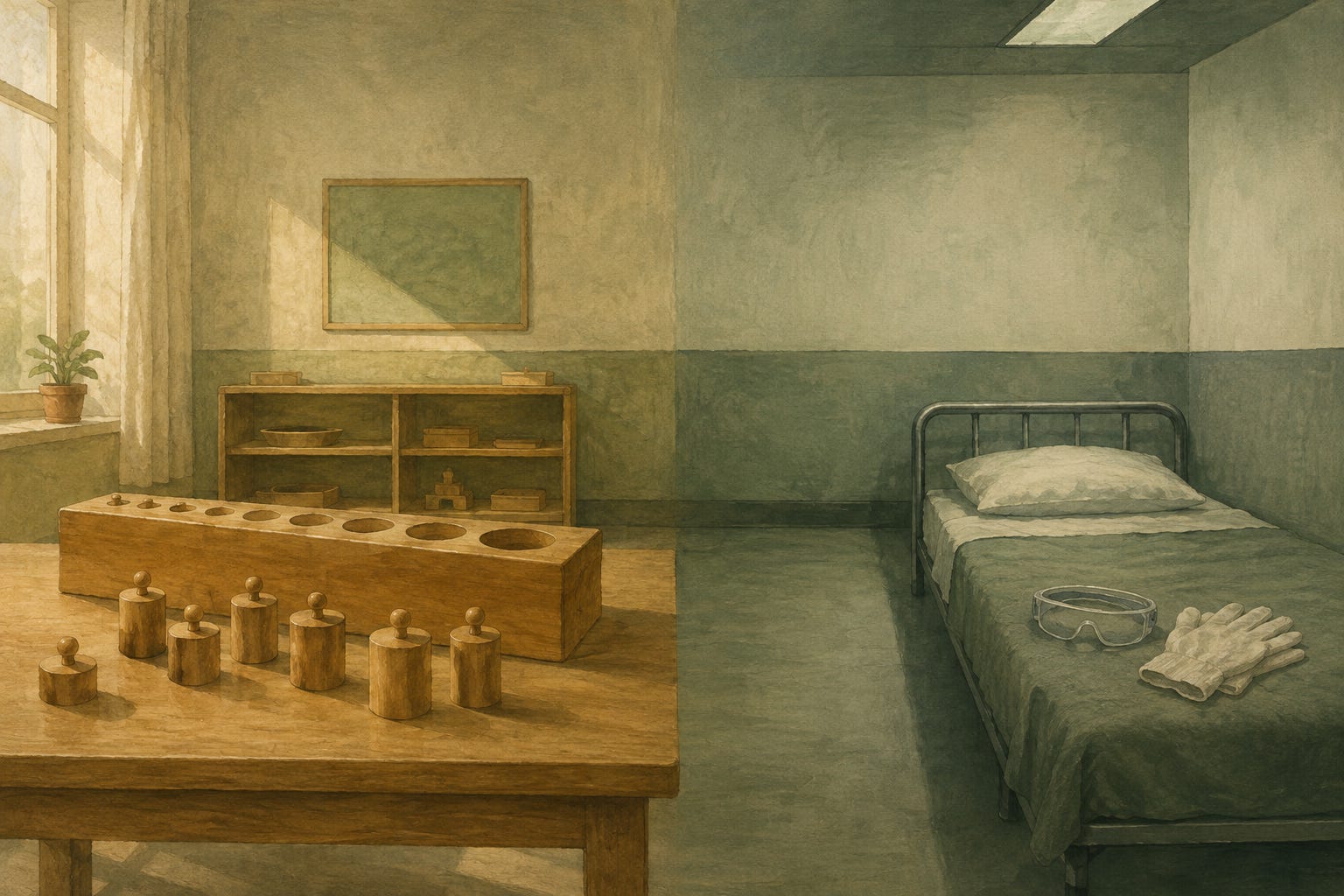
Among the objects she brought was a solid wooden block holding a row of cylinders. Each fit precisely into its own socket. Some tall and wide, some short and narrow. A small knob let a child lift each one out, examine it, and put it back where it belonged.
No prize. No sound. No story. Just a problem: take them out, put each one back.
One day a girl of about three sat down with it.
She took the cylinders out one at a time, set them aside, then began fitting them back, comparing each one against the openings until it settled into place.
Then she took them out again.
And put them back again.
Montessori watched her face. The child was not merely interested. Her attention was fixed with an intensity Montessori had never seen in a child that young — and until that moment, even she had largely accepted the prevailing belief that small children simply don’t have stable attention.
She started counting.
Five times. Ten. Fifteen. Still going.
So she decided to test it. She walked over, took hold of the little armchair the girl was sitting in, and lifted both chair and child onto a table.
That would surely break it.
Instead the girl gathered the cylinders into her lap, balanced the block across the arms of the chair, and kept working.
Montessori tried again. She asked the other children to sing. Their voices filled the room. The song rose around the girl as she went on lifting and comparing and replacing. The song ended. The room went quiet.
She continued.
Forty-four times.
Then she stopped — and she did not look exhausted or dazed. Montessori described her as resembling someone waking from a deep and refreshing sleep. Her eyes shone. Her face was peaceful. Something in her seemed not to have been consumed by that concentration but restored by it.
She had worked until some internal need was satisfied. Then she rejoined the room.
The cylinder block cannot explain what happened. The object was trivial. She’d learned no fact that could account for that intensity. No adult had commanded, praised, corrected, or rewarded her.
She chose it freely. She repeated it as long as something inside her required. She found her own errors and fixed them herself. And she came out of it more peaceful, more alert, and more fully herself than she went in.
Montessori started looking for it in the other children.
She saw it again. Not always with the same object — one child arranging things by size, another tracing a shape, another washing a table, buttoning, pouring, carrying water without spilling it.
The activity varied. The pattern didn’t.
And then the part nobody was expecting. The change did not stay inside the activity.
Children who had moved chaotically through the room began choosing their work calmly. Children who had fought every adult became cooperative. Children who’d clutched objects possessively started putting them back. The passive ones became energetic. The noisy ones became peaceful. Patience appeared. Perseverance. Self-command. Independence. Consideration for others.
None of it had been taught.
No lesson on patience produced the patience. No lecture on obedience produced the obedience. No reward system produced the perseverance. No punishment produced the self-discipline.
The qualities arrived together — as though they weren’t separate virtues installed from outside, but related expressions of a single order developing within.
She had accepted a job keeping tenement children occupied. What she found was that under certain conditions, the personality itself reorganizes.
She called it normalization.
Now hold that against a room in Montreal, forty-seven years later.
In 1954, psychologists at McGill placed an advertisement seeking volunteers. The work sounded effortless — rest quietly for several days while researchers studied reduced sensory stimulation. No labor, no tests, no pain. Twenty dollars a day, well over two hundred in today’s money. For a college student it looked like the easiest money he’d ever make.
The room seemed comfortable. A bed. Meals brought in. Nurses checking regularly. Nothing about it suggested danger.
The researchers wanted one thing: what happens when a healthy human mind is deprived of ordinary experience?
So they took it away. Translucent goggles that let light through but no recognizable shapes. Cotton gloves and cardboard sleeves to dull the hands. White noise through speakers. Mostly confined to bed. Hour after hour, nothing meaningful to see, hear, touch, or do.
Nothing painful was added. Ordinary experience was simply subtracted.
At first they were bored. Some slept. Some sang to themselves, replayed old memories, did mental arithmetic — anything.
But the mind proved remarkably unwilling to sit idle.
Within hours, many found it hard to think clearly. Thoughts came apart. Concentration deteriorated. Time lost its rhythm. Then the emotional weather turned — restlessness, sharp anxiety, irritability, a strange sense of detachment, as though the world had gone dreamlike.
Then the hallucinations. Flashes of light and moving patterns at first. Then vivid, elaborate scenes. One man watched squirrels marching through the room carrying sacks over their shoulders. Another saw processions of eyeglasses drifting past. Faces, animals, voices — utterly real, and known to be impossible.
These were healthy young adults with no history of mental illness.
After a day or two, many showed symptoms resembling acute psychosis. Most never finished. Despite the money, despite the comfort, they begged to leave.
Nobody poisoned them. Nobody tortured them. Nobody injured them.
They were simply deprived.
Put the two rooms side by side, because they are mirror images.
Montessori took children everyone regarded as disordered, supplied the conditions their development required, and watched concentration, order, independence, and joy appear — unbidden, child after child.
The McGill researchers took adults everyone regarded as healthy, removed the conditions their minds required, and watched thinking degrade, emotion destabilize, and perception itself break down — subject after subject, within days.
One supplied the conditions and health appeared.
The other withdrew them and health dissolved.
Two laboratories, half a century apart, unaware of each other, reading the same law of nature from opposite directions:
The healthy functioning of a human consciousness depends on the presence of objective conditions in its environment.
There’s one more turn, and it’s the one that should worry you.
Twelve years after those volunteers fled that room, Ayn Rand stood in front of an audience in Boston and drew the conclusion the researchers had been too careful to draw themselves.
If depriving the mind of mere sensation does that in days, she asked, what happens when the deprivation reaches higher — when what’s withheld isn’t stimulation but the mind’s actual nourishment? Not sights and sounds. Values. Things to gain and keep and love.
Sensory deprivation is the acute laboratory form: seal a man away from sight and sound and his mind starves within hours.
Value-deprivation is the chronic, civilizational form. No goggles, no cubicle, no researchers. Just a life, or a culture, gone empty of chosen purposes, meaningful work, real things worth having. The McGill room compressed into seventy-two hours what a value-starved existence does across decades — slowly enough that nobody ever calls it an experiment.
And she named the symptom by which the chronic form hides itself. Like carbon monoxide, value-deprivation leaves its victims with no awareness of what they’re missing. The specific symptom, she said, is a gradual lowering of one’s expectations.
Stop on that sentence, because we’ve already met it.
A civilization whose expectations of inner life sink year after year — which absorbs each new increment of anxiety and distraction and joylessness and quietly adjusts its baseline to fit — is not being realistic about the human condition.
It’s displaying the diagnostic sign of the deprivation itself.
We have a name for that gradual lowering of expectations.
We call it the new normal.
I’m writing a book called The Achievement of Normal — this argument at full length. It comes out this year. Subscribe and you’ll know the day it does.